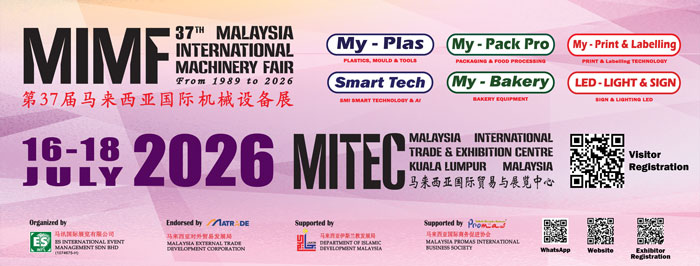
Malaysia has no shortage of trade exhibitions, but MIMF 2026 looks set to matter for reasons beyond booth count and visitor traffic. When the 37th Malaysia International Machinery Fair opens at MITEC from 16 to 18 July, it will bring together two major shows under one umbrella: MY-PLAS 2026 for plastics, mould and tools, and MY-PACK PRO 2026 for food processing, packaging and bakery equipment.
On paper, the scale is already significant. Organisers expect more than 10,000 trade visitors, over 700 booths, and strong overseas participation, with around 70% of exhibitors coming from outside Malaysia. But what stands out more is the way this year’s edition ties together three themes that are becoming harder to separate in modern manufacturing: automation, cross-border trade and halal-ready production.
A 37-Year Exhibition Adapts to a New Industrial Era
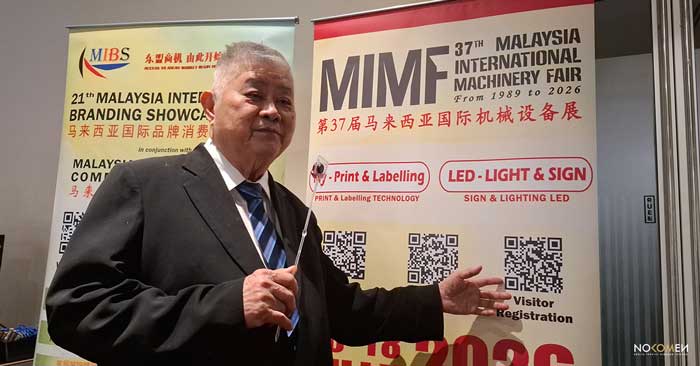
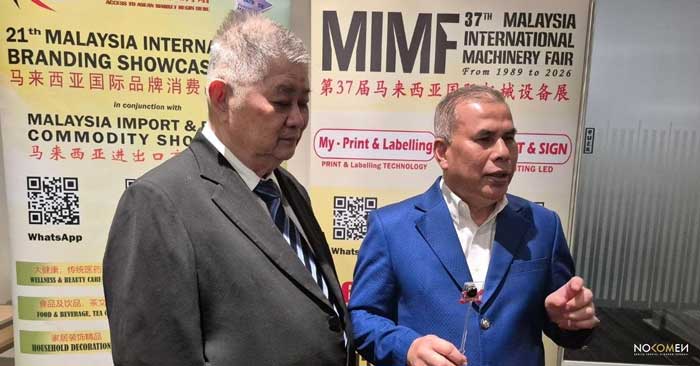
At the soft launch, Lady Puan Sri Dr. Susan Cheah, Honorary Life President of Malaysia Promas International Business Society (PROMAS), described the event in broader terms than a conventional industrial fair.
“MIMF 2026 is more than just a trade exhibition; it is a gateway to opportunities.”
That line sums up the real story behind this year’s programme. The exhibition is being positioned not just as a place to view machines, but as a platform for business matching, technology transfer and international market access. For Malaysian manufacturers, especially SMEs, that distinction matters. In a competitive regional market, the value of a trade show is no longer just product visibility. It is about how quickly an exhibitor can find buyers, partners, suppliers or distributors who can move a deal forward.
Cheah also said the fair is intended to support “cross-border collaboration, technology transfer, and industrial advancement,” a framing that fits Malaysia’s wider push toward Industry 4.0, digitalisation and smarter factory operations.
AI and Smart Manufacturing Take Centre Stage
This year’s floor plan reflects that direction. MIMF 2026 will cover plastics processing, mould and tooling, packaging technology, food processing, bakery equipment, industrial automation, AI and smart manufacturing.
Among the technologies expected to be showcased are:
- plastic injection moulding machines
- blow moulding and extrusion systems
- industrial laser cutting machines
- packaging and labelling systems
- food and beverage processing equipment
- halal food processing machinery
- industrial robots and automation systems
- AI smart manufacturing solutions
- smart factory and Industry 4.0 technologies
- precision moulds, tools and industrial components
There will also be live machinery demonstrations, which often give trade visitors a better sense of real-world capability than spec sheets alone. In industrial exhibitions, those live demos can be the difference between a casual visit and a serious purchase discussion.
One area likely to draw attention is the dedicated AI Smart Manufacturing & Industry 4.0 Pavilion, where exhibitors are expected to present smart factory systems, Industrial Internet of Things (IIoT) tools, robotics automation and digital production management solutions. That is particularly relevant for Malaysian manufacturers looking to modernise without fully rebuilding their production lines from scratch.
Business Matching and Networking Programmes
A recurring problem with big trade fairs is that they can become heavy on visibility and light on outcomes. MIMF 2026 appears to be trying to address that through a more deliberate business matching structure.
The programme includes:
- Hosted Buyer Programme: Qualified trade buyers from outside Kuala Lumpur, Selangor, and Seremban may receive complimentary coach transportation, one night’s hotel accommodation, or trade associations organising more than 20 buyers may receive RM2,000 in activity support.
- International Buyer Networking Programme: Professional buyer delegations from multiple countries will participate in face-to-face sourcing meetings with exhibitors.
- Packaging & Food Processing Business Matching Session: Dedicated sessions connecting exhibitors with buyers and manufacturers.
- International Industry Conference: Leading experts and decision-makers from Malaysia, China, and globally will deliver keynote presentations on industrial innovation, market trends, smart production, and investment opportunities.
- International Plastics Industry Investment Forum: Industry associations, international experts, and government representatives will discuss Malaysia’s plastics industry development, ASEAN manufacturing trends, green technologies, and investment opportunities.
That last part is worth noting. Instead of relying only on walk-in traffic, the Hosted Buyer Programme offers practical incentives such as return coach transport, one night of hotel accommodation, or support for trade associations that bring in larger buyer groups. It is a simple move, but one that could improve the quality of leads on the show floor.
If that works as intended, MIMF 2026 may deliver something more useful than headline visitor numbers: better buyer intent.
Halal Manufacturing Automation: Malaysia’s Underserved Niche
Another notable part of this year’s edition is the expanded halal food processing and packaging focus. That is not just a branding exercise. It reflects a real commercial position Malaysia continues to hold in the regional and global halal economy.
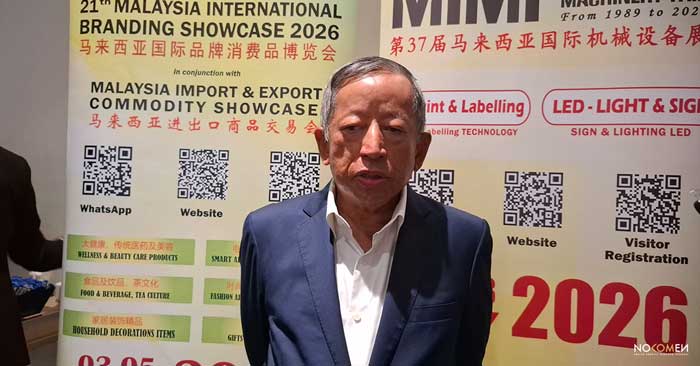
Datuk Zainal Abiddin bin Jaafar, Chairman of Zajas Sdn Bhd and strategic partner of the Malaysia International Halal Academy (MIHA), made that point directly during the launch.
“The Halal industry continues to play a significant role in Malaysia’s global positioning.”
He added that demand is growing for halal-compliant machinery and technologies, and that MIMF 2026 offers a useful platform for showcasing solutions that support both industrial growth and halal industry development.
That matters because halal manufacturing is no longer just about certification at the final product stage. Equipment design, hygiene systems, process control, packaging integrity and traceability all increasingly feed into how food brands manage compliance and export readiness. For equipment suppliers, that creates a more specialised market. For local manufacturers, it opens opportunities beyond the domestic market into ASEAN, the Middle East and other halal-focused regions.
The Trade Infrastructure Behind the Exhibition
The exhibition’s international profile also deserves attention. Companies from China, South Korea, Japan, Singapore, Indonesia, Bangladesh, Thailand, Vietnam, India, Germany and Malaysia are expected to participate. Organisers also say official industry delegations will come from Guangdong, Zhejiang, Fujian, Shanghai and Beijing, alongside other overseas groups.
Backed by official recognition from MATRADE, the exhibition is supported by Malaysia Convention & Exhibition Bureau (MyCEB), the Department of Islamic Development Malaysia (JAKIM), Malaysia Promas International Business Society (PROMAS), Dewan Perniagaan Usahawan Malaysia (DPUM), Malaysia-China International Trade Link Association (MACITA), and more than 60 local and international trade and industry associations, the event is clearly being positioned as a regional business platform rather than a purely domestic show.
Cheah pointed to that international role in her remarks, saying PROMAS continues to connect Malaysian enterprises with overseas buyers, manufacturers and investors through long-term partnerships.
“These engagements go beyond transactions — they foster enduring relationships that catalyse joint ventures, facilitate innovation, and promote long-term economic collaboration.”
That is an ambitious goal, but it reflects a useful reality: for many manufacturers, the most valuable part of attending an exhibition is not necessarily the machine on display, but the relationship that follows.
Strategic Significance for Malaysia’s Industrial Future
From a broader industry perspective, MIMF 2026 arrives at a time when manufacturers are under pressure from several directions at once. They need to improve productivity, reduce waste, digitise operations, manage labour constraints and stay competitive on cost. At the same time, buyers increasingly expect speed, traceability and compliance across the supply chain.
That is why the mix at MIMF 2026 feels timely.
Plastics and mould technology remain essential to industrial supply chains. Packaging and food processing are being reshaped by automation and export requirements. AI and smart manufacturing are moving from conference-stage talking points into real procurement decisions. And halal-compliant production is becoming a commercial capability, not just a regulatory box to tick.
In that sense, MIMF 2026 is a useful snapshot of where Malaysia’s manufacturing priorities are heading: not toward one single sector, but toward a more connected industrial ecosystem.
Why SMEs Should Pay Attention
The event is also expected to provide a dedicated platform for Malaysian SMEs and start-ups to present products, meet distributors and connect with international buyers. For smaller firms, that matters just as much as the presence of large machinery brands.
SMEs often do not have the budget for long overseas roadshows or repeated export market visits. A well-run exhibition can compress months of prospecting into a few days. If MIMF’s buyer matching and international networking sessions are executed well, local businesses could gain exposure that would otherwise be difficult and expensive to secure.
What to Make of MIMF 2026
MIMF 2026 is large enough to attract attention on scale alone, but its significance goes beyond the numbers. What makes this edition worth watching is the combination of smart manufacturing, international sourcing, halal processing and structured buyer engagement under one roof.
The exhibition will run from 16 to 18 July 2026, from 10:00am to 6:00pm, at Halls 2, 3 and 4, MITEC, Kuala Lumpur, with the official opening scheduled for 16 July at 11:00am.
For anyone tracking where Malaysia’s industrial sector is heading, this is not just another machinery fair. It is a closer look at how the country wants to position itself in the next phase of regional manufacturing: more automated, more connected, more export-ready, and increasingly more specialised.

PERINGATAN:
Nokomen.com tidak bertanggungjawab terhadap komentar yang diutarakan melalui laman sosial ini. Ia merupakan pandangan peribadi pemilik akaun dan bukan sesekali daripada pihak kami. Segala risiko akibat sebarang komentar yang disiarkan menjadi tanggungjawab pemilik akaun itu sendiri.